


Celebrating Black Architects & Designers: Sheila Bridges
- Madison Bennett
- Feb 12, 2021
- 5 min read

This week, in continuation of our Black History Month series, I am highlighting another multi-hyphenate, extremely talented designer, and one of my role models, Sheila Bridges. Bridges is not only a celebrated interior designer but also an author, a TV host, and a product designer. She has been named “America’s Best Interior Designer” by CNN and Time Magazine. She is one of the founding members of the Black Artists + Designers Guild, a directory of black creatives, including artists, architects, and interior designers, whose main goal is to challenge the lack of representation of Black talent and culture in the design industry by providing visibility and opportunities to its members.

Sheila Bridges was born in Philadelphia in 1964 to a dentist and a teacher. She moved to New York in 1986, where she currently resides. Bridges holds a sociology degree from Brown University in addition to her degrees from Parsons School of Design in New York and Polimoda in Florence, Italy.
After graduating from Brown, Bridges originally envisioned a career in advertising (her thesis was on gender and race stereotypes in print ads). She moved to New York with the hopes of becoming an account executive at an advertising firm. She was always creative but wanted to be in business, and at the time advertising seemed like a good mix for her. However, she was not very successful at landing a job in advertising and decided to try her chance in retail instead. She got a job at Bloomingdale’s as a trainee buyer, which she didn’t enjoy much. While working at Bloomingdale’s, she started her interior design degree at Parsons School of Design and then began working at an architectural firm. In her own words, “Something just clicked. I could always see myself doing this. I was suddenly at home”. After working at a few different architectural and design firms, she sensed it was time to strike out on her own and founded her interior design firm in 1994. She says, “I guess I sort of figured out that if I’m going to work this hard, I’m sort of helping somebody else achieve their dream rather than working hard to achieve my own”.
Her clientele list includes many high-level entertainers, entrepreneurs, and business professionals including Sean Combs (P. Diddy), Andre Harrell, and designing former President Bill Clinton’s Harlem offices.
According to Cassi Owens of the Philadelphia Inquirer, “Her career achievements are exceptional for any designer, but she’s done them as a Black woman in an industry that famously struggles with diversity”.


She hosted her own show (‘Sheila Bridges - Designer Living’) on the Fine Living Network in the early 2000s, for four consecutive seasons until she was diagnosed with alopecia, an autoimmune disorder that causes hair loss.
She quit her show and took a break from designing to cope with the public’s perception of beauty and traumatizing effects of hair loss. She says, “something that was very, very private was sort of happening to me in a very public way. I was experiencing tremendous sense of shame, and of loss, and it was just a very, very challenging, you know, time for me personally." Later she returned to the design scene as a stronger woman who “was not defined by that hair”, but by her talent, experience, and creativity. In her own words, “at the beginning of (her) career, (she) didn't feel like (she) fit in, which is a continuing challenge for nonwhite designers, from product to fashion. Whether it's as a Black interior designer or as a woman who has lost her hair because of an autoimmune disorder, (she) tries to be as visible as possible as a role model. (She has) spent (her) professional life focused on beauty. A personal transformation made (her) redefine what beauty is. “
Nonetheless, she is one of the most successful designers in America and continues to create inviting spaces with bold designs and strong color choices. She is very talented at switching between styles, from contemporary to classical, and bases her designs on the philosophy of creating spaces that will last. Her style can be described as bold and eclectic, though she personally doesn’t like the latter word. She “loves mixing old and new, modern and antique, and putting patterns and prints together in unpredictable ways”. According to Bridges, her style “could be described as modern classic… but a bit more edgy or urban.” She is mostly known for her bold color choices and experimenting with different color combinations. She likes to design low maintenance homes for high maintenance people. According to Mitchell Owens, decorative arts editor at Architectural Digest, Sheila Bridges “processes a world of inspirations through a very American prism of relaxation, of a lack of quote-unquote rules. Her rooms are super approachable. I know that she herself is sort of an introvert, but she creates the most friendly rooms possible.”


One of her most iconic designs is the Harlem Toile pattern that she created, earning her the nickname Harlem Toile Girl. Toile De Jouy is a traditional 18th-century French pattern that historically features pastoral scenes from France. Bridges was always drawn to the pattern's idyllic vignettes, as she finds inspiration from the historical narratives that influence design, but she had trouble finding one that would reflect her own story or celebrated Black culture. So, she substituted the traditional scenes of France's pastoral landscapes for those that reflect her African American heritage, address the stereotypes surrounding her race, and pay homage to her current hometown of Harlem. Harlem Toile features scenes of African Americans doing “stereotypical activities” such as picnicking with watermelon, eating fried chicken and playing basketball. The pattern puts Black faces in a context where they lack representation and subtly criticizes the way African Americans have been represented historically. Initially, she created the design for her own kitchen wall but later decided to print it for trade. The Harlem Toile now comes in wallpapers, furniture, apparel, and accessories in various colors and is featured in many galleries and museums around the world, including the Smithsonian Cooper-Hewitt National Design Museum’s permanent wallpaper collection.


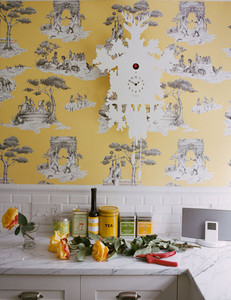
Bridges has always been very outspoken on the topic of diversity and lack of representation of Black talents and tries to make a change by creating visibility and opportunities. “The design world is getting a little bit better, but there’s still a lot of room for growth and change and inclusivity and diversity and all those things that we’re trying to work toward,” she states, “none of us want to be the only one. I don’t want my legacy to just be about my own work. It’s also about bringing other people into the fold.”


You can learn more about Sheila Bridges via her memoir ‘The Bald Mermaid’.

xoxo,
Madison Mae
References:
Images:
1 - Image via Sheila Bridges
2 - Image of Harlem Town House via Sheila Bridges
3 – Image of West Village Duplex via 1st Dibs
4 – Image of Harlem Town House via Sheila Bridges
5 – Image via House Beautiful
6 – Image via Sheila Bridges
7 – Image via Sheila Bridges
8 – Image of Hudson Valley Cottage via Sheila Bridges
9 – Image via The New York Times
10 – Image via Sheila Bridges
11 – Image of Harlem Town House via Sheila Bridges


Comments